
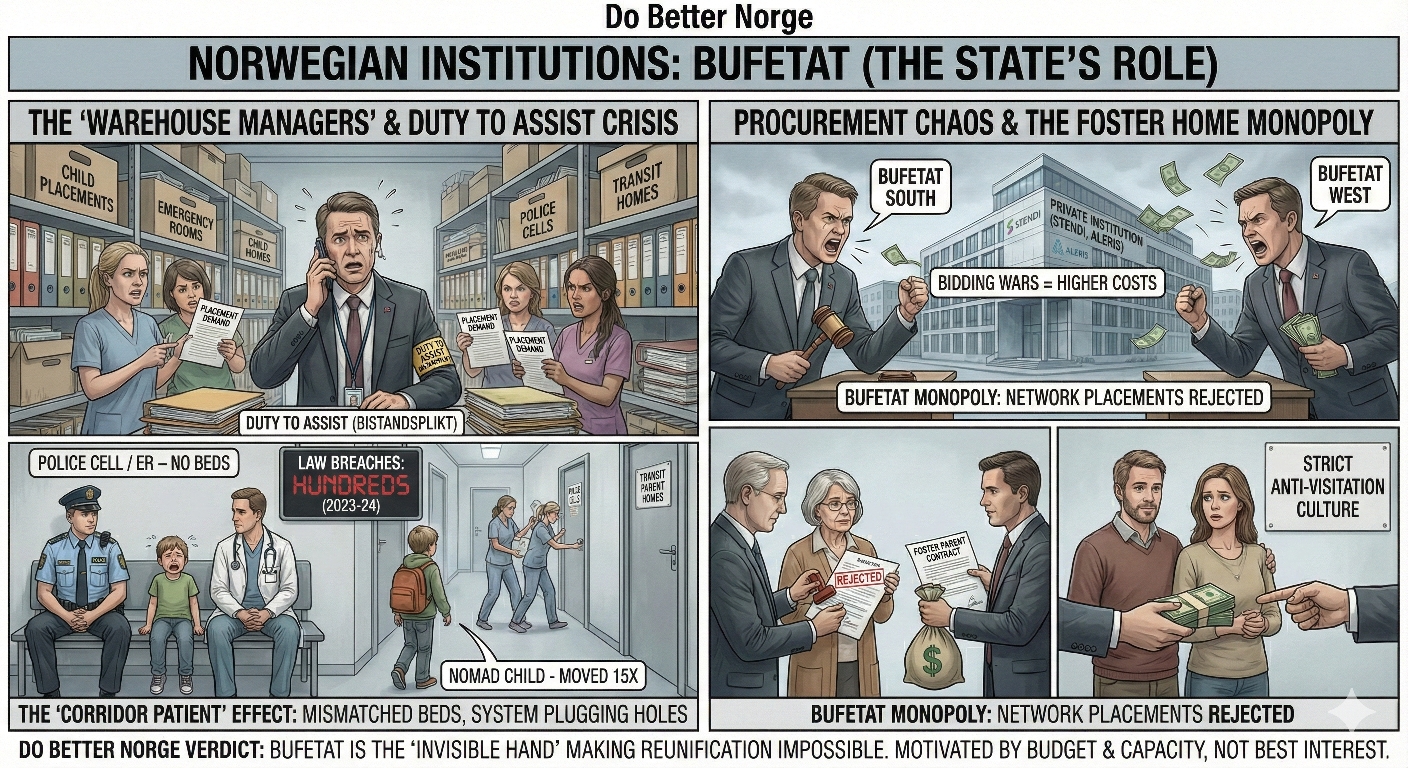
Bufetat: The "Warehouse Managers" of Child Welfare
While the local municipal Barnevern makes the decision to take a child, they usually have nowhere to put them. This is where Bufetat (The Office for Children, Youth and Family Affairs) enters. They are the state agency responsible for finding foster homes and institutions. In practice, they act as the gatekeepers who control the "supply" of beds for removed children.
1. The "Duty to Assist" Crisis (Bistandsplikt)
By law, when a municipality demands a placement for a child, Bufetat has a Duty to Assist (Bistandsplikt). They must find a bed. However, recent years have exposed a total collapse in this legal guarantee.
- Systemic Law Breaches: In 2023 and 2024, the State Administrators (Statsforvaltere) found that Bufetat broke the law in hundreds of cases by failing to find homes for children. This leaves children stuck in emergency rooms, police cells, or temporary "transit" homes for months.
- The "Corridor Patient" Effect: Because Bufetat cannot find suitable homes, children are often placed in whatever bed is empty, regardless of whether it matches their needs. This mismatch leads to the "nomad child" phenomenon, where children are moved 10-15 times because the system is plugging holes rather than providing care.
2. "Procurement Chaos" (Innkjøpskaos)
A government-appointed expert committee recently slammed Bufetat for how it buys institutional places from private companies (like Stendi or Aleris).
- Bidding Wars: Different regions of Bufetat (e.g., Bufetat South vs. Bufetat West) actually compete against each other for the same private institution spots. This drives up the cost and means the child who gets the bed is often the one whose region pays the most, not the one who needs it most.
- No Control: The report concluded that the state "lacks sufficient control" over capacity. They literally do not know if they have enough beds for the children they plan to take next month.
3. The Foster Home Monopoly
Bufetat has a monopoly on recruiting and approving foster homes. Parents fighting for custody often propose aunts, grandmothers, or friends as alternative caregivers. Bufetat frequently rejects these "network placements" in favor of strangers.
- The Recruitment Failure: Despite spending millions on ad campaigns, Bufetat consistently fails to recruit enough foster parents. Yet, they maintain strict, often bureaucratic criteria that disqualify loving family members for minor reasons (e.g., house size or age).
- Power over Visitation: Once a child is in a Bufetat-managed foster home, Bufetat manages the "foster parent contract." They pay the foster parents. This creates a financial loyalty structure where foster parents are incentivized to follow Bufetat's strict anti-visitation culture rather than facilitate contact with biological parents.
Do Better Norge Verdict: Bufetat is the "invisible hand" that makes reunification nearly impossible. Even if a judge says a child could go to a specialized foster home nearby, if Bufetat says "we don't have one," the child stays in an institution 500km away. Parents must understand that Bufetat is motivated by budget and capacity, not your child's best interest.
Sources:
Comments (0)
Please log in to post comments.
No comments yet. Be the first to comment!