
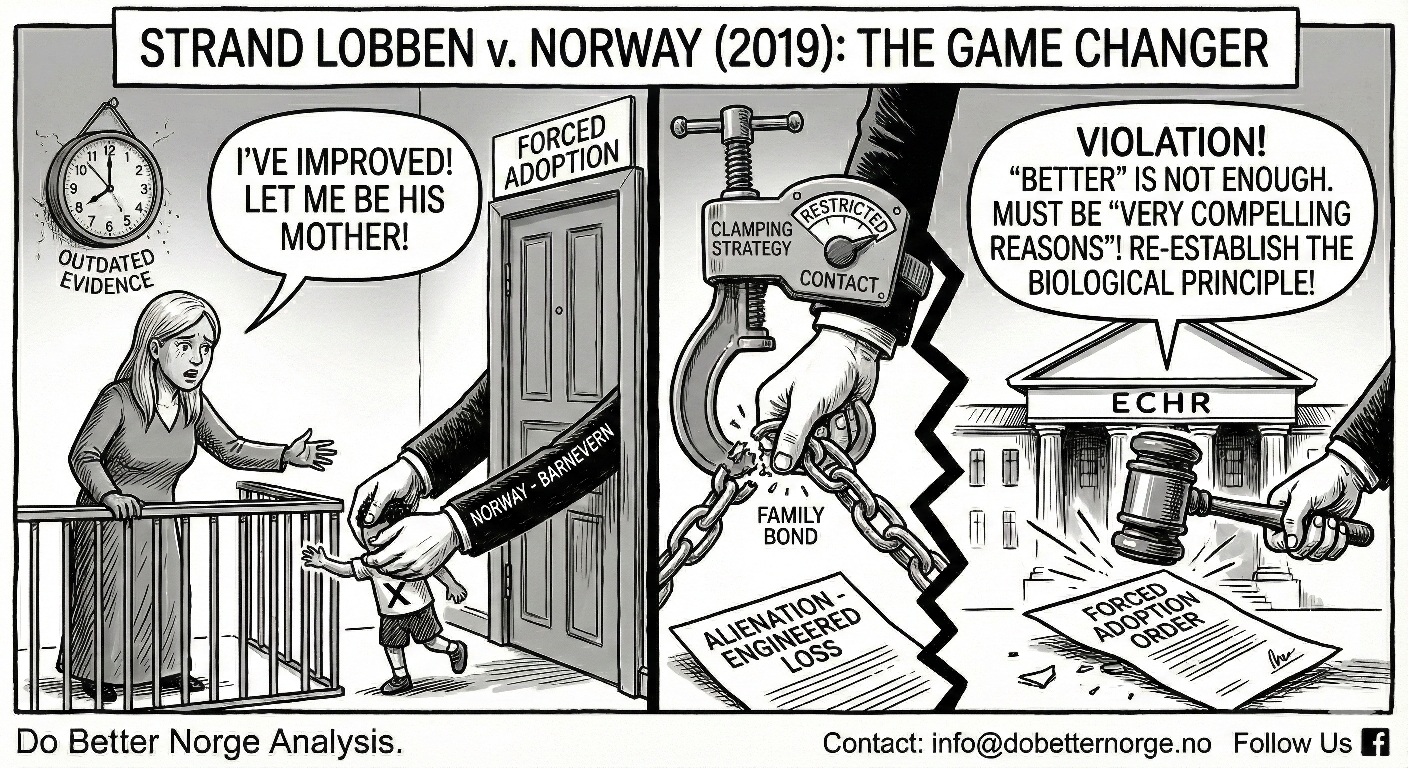
Strand Lobben v. Norway (2019): The Grand Chamber Earthquake
The judgment in Strand Lobben and Others v. Norway (Application no. 10724/13) is arguably the most significant legal defeat in the history of the Norwegian child welfare system. Decided by the Grand Chamber—the highest level of the European Court of Human Rights—it signaled an end to "business as usual" for Barnevernet’s practice of forced adoptions.
1. The Facts: A Decade of Legal Warfare
Trude Strand Lobben’s son was removed from her care at a mother-and-child center just three weeks after birth in 2008. What followed was a ten-year battle against a system that had decided, almost from day one, that the removal would be permanent.
- Institutional Hostility: The initial removal was based on the mother’s perceived "lack of intuitive parenting skills," a highly subjective metric used by staff at the center.
- Contact Sabotage: For years, her visitation was restricted to just a few hours a year. This prevented the child from developing a bond with his biological mother, a fact the state later used to justify adoption.
- The Final Blow: In 2011, the Norwegian authorities authorized the foster parents to adopt the boy, legally erasing Trude as his mother and changing the boy's name and identity against her will.
2. The ECHR’s Crushing Critique: Procedural Failure
The Grand Chamber did not just find a violation; they exposed a methodological bias in the Norwegian judiciary. The Court’s 13-4 vote sent a clear message on three critical fronts:
A. The "Clamping" Strategy (Contact as a Weapon)
The Court observed that the Norwegian authorities used a "vicious cycle" logic. By setting visitation so low, they guaranteed that the child would eventually become "more attached" to the foster parents. The ECHR ruled that the state cannot create a situation of alienation and then use that alienation as proof that the biological mother is no longer needed.
B. The Evidentiary Vacuum
The ECHR slammed the Norwegian courts for relying on psychological reports that were three years old at the time of the adoption trial. The domestic courts had refused to order new expert evaluations, assuming that parenting skills are static and cannot improve. The ECHR ruled this was a fundamental breach of the right to a fair process.
C. Misunderstanding "The Child's Best Interest"
Norway argued that adoption was in the child's best interest because he was "well-settled." The ECHR corrected this: while a child's comfort matters, it does not automatically override the right to a family of origin. The Court established that "very compelling reasons" are required to sever family ties, not just the promise of a "better" life elsewhere.
Do Better Norge Analysis: The Biological Principle Reborn
Before this case, Norwegian courts often treated the "biological principle" as a mere tie-breaker. Strand Lobben forced a U-turn. In 2020, the Norwegian Supreme Court had to issue three new judgments to align with this ruling.
Strategic Advice for Parents:
- Fight the "Status Quo": Barnevernet wins by stalling. Use this case to demand immediate increased visitation to prevent the "alienation" described by the ECHR.
- Demand Fresh Evidence: If the psychologist’s report in your case is more than 6-12 months old, use Strand Lobben to demand a new, independent evaluation.
- Reunification is the Law: Remind the court that under ECHR law, the primary goal of any care order must be family reunification. Anything else is a human rights violation.
Official Sources and References:
- Full Grand Chamber Judgment: Strand Lobben and Others v. Norway (App no. 10724/13)
Comments (0)
Please log in to post comments.
No comments yet. Be the first to comment!