
Taking it to Court: The § 36 Legal Process
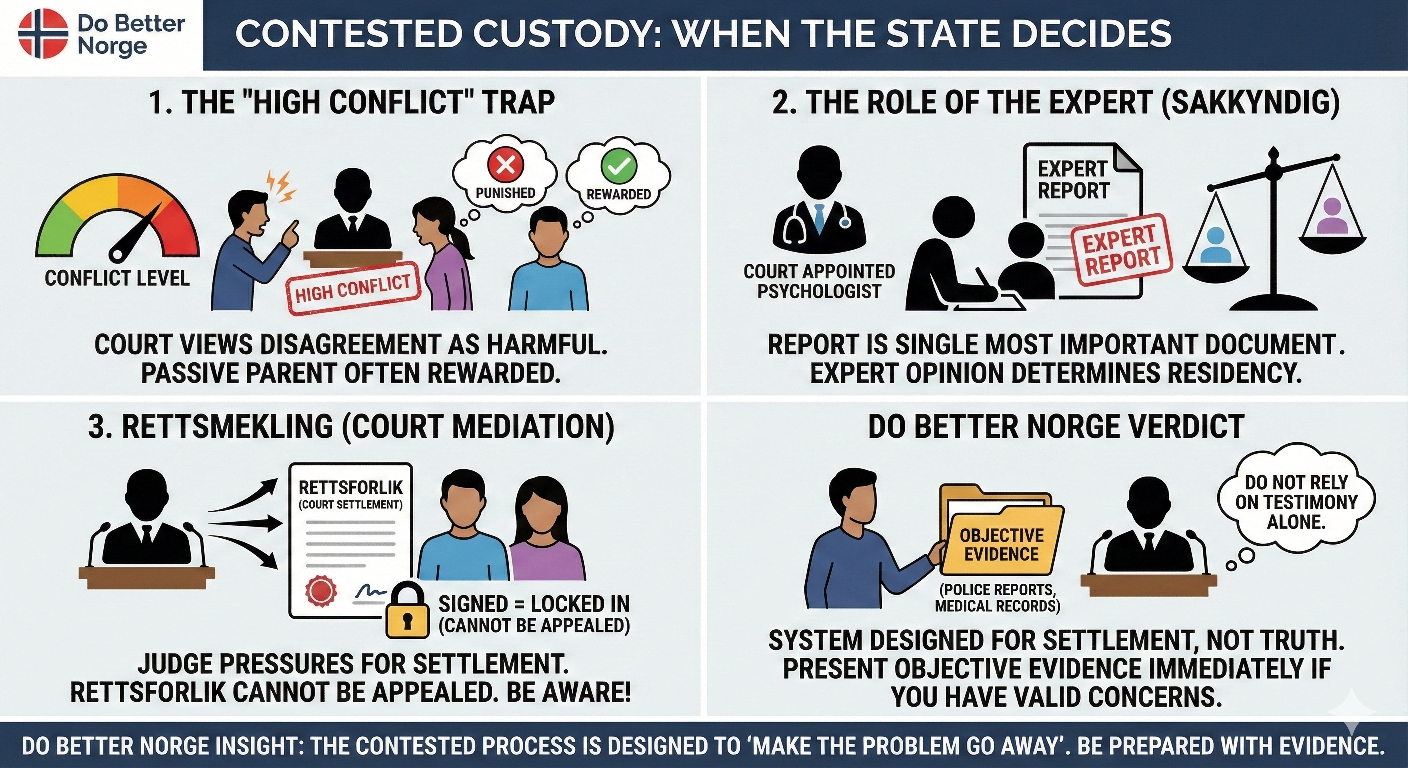
When parents cannot reach a private agreement or settle during mediation, the dispute enters the formal judicial system under Section 36 of the Children Act (Barneloven). This is a high-stakes, specialized legal path where "the law" often takes a backseat to psychological assessments and the subjective interpretation of "the child's best interest."
1. The Preparatory Phase: Step-by-Step
Before a case ever reaches a courtroom for a final trial, it must navigate a series of mandatory hurdles. In Norway, the court's primary goal is to force a settlement rather than issue a judgment.
- The Lawsuit (Stevning): One parent files a formal claim to the District Court (Tingretten). This must be accompanied by a valid Mediation Certificate (Meklingsattest) not older than 6 months.
- Preparatory Meetings (Saksforberedende møter): Regulated by § 61, these are informal yet critical hearings. Unlike a trial, there is no witness stand. Instead, the judge, parents, and an expert (psychologist) sit around a table to "discuss" solutions.
- Trial Periods: Often, the court will establish a temporary visitation or residence schedule to "test" how it works for 3–6 months before holding the next meeting.
2. The Role of the Expert (Sakkyndig)
Under Barneloven § 61, No. 1 and 3, the court almost always appoints an expert—usually a psychologist. This individual is technically an advisor to the court, but in practice, they are the de facto decision-maker.
A. The "Conflict" Weapon
The system is obsessed with the level of conflict between parents. If an expert labels the situation as "High Conflict," the court's priority shifts from finding the truth about parenting ability to "shielding" the child from the friction. Often, this results in the parent who raises safety concerns being viewed as the "source" of the conflict, leading to reduced visitation.
B. Status Quo Bias
Norwegian courts place immense weight on "stability." If a child has lived primarily with one parent during the months or years the legal battle has lasted, the expert will almost inevitably recommend maintaining that arrangement. This creates a "race to the finish line" where the parent who has physical control of the child at the start of the case has a massive advantage.
3. The Final Verdict: "Barnets Beste"
If no settlement is reached during the preparatory phase, the case goes to a Main Hearing (Hovedforhandling). This is a traditional trial with witnesses and cross-examination.
- The Expert's Recommendation: Research and legal practice show that judges follow the expert's recommendation in 80–90% of cases. If the psychologist sides against you, the chances of a judge ruling in your favor are statistically slim.
- The Right to be Heard: Children aged 7 and older (and younger children capable of forming views) must be heard. However, the expert usually conducts this interview, and how they "interpret" a child's words is entirely subjective.
Do Better Norge Verdict: A Psychological Minefield
The § 36 process is not about "winning" a legal argument; it is about managing the perception of the court-appointed psychologist. Because the judge has no psychological training, they outsource the verdict to the expert.
Strategic Advice:
- Choose your lawyer carefully: You need someone who knows the "cliques" of psychologists used by your local court and who can effectively challenge an expert’s methodology.
- Stay "Solution-Oriented": Even if you are angry, appearing "high conflict" in front of the expert is a death sentence for your case. Focus entirely on the child's needs, not the other parent’s failures.
- Record Everything: While you cannot record the courtroom, you have the legal right to record your own private meetings with the expert to ensure their final report accurately reflects what was said.
Official Sources and References:
- The Children Act: Act of 8 April 1981 No. 7 relating to Children and Parents (The Children Act)
- Expert Guidelines: National Guide for Experts in Parental Disputes (Norwegian)
- Critical Research: Children’s Participation in Family Law Proceedings - Scandinavian University Press
Comments (0)
Please log in to post comments.
No comments yet. Be the first to comment!