Navigating Child Resistance: A Blueprint for Re-establishing Family Bonds
🌐EN
📅February 17, 2026
💡 How to use: Use zoom buttons or scroll wheel to zoom in/out. Click and drag to pan around when zoomed. Double-click to zoom in. Press Reset to return to original view.
Expert Assessment & Structured Reconciliation: A Blueprint for High-Conflict Reunification
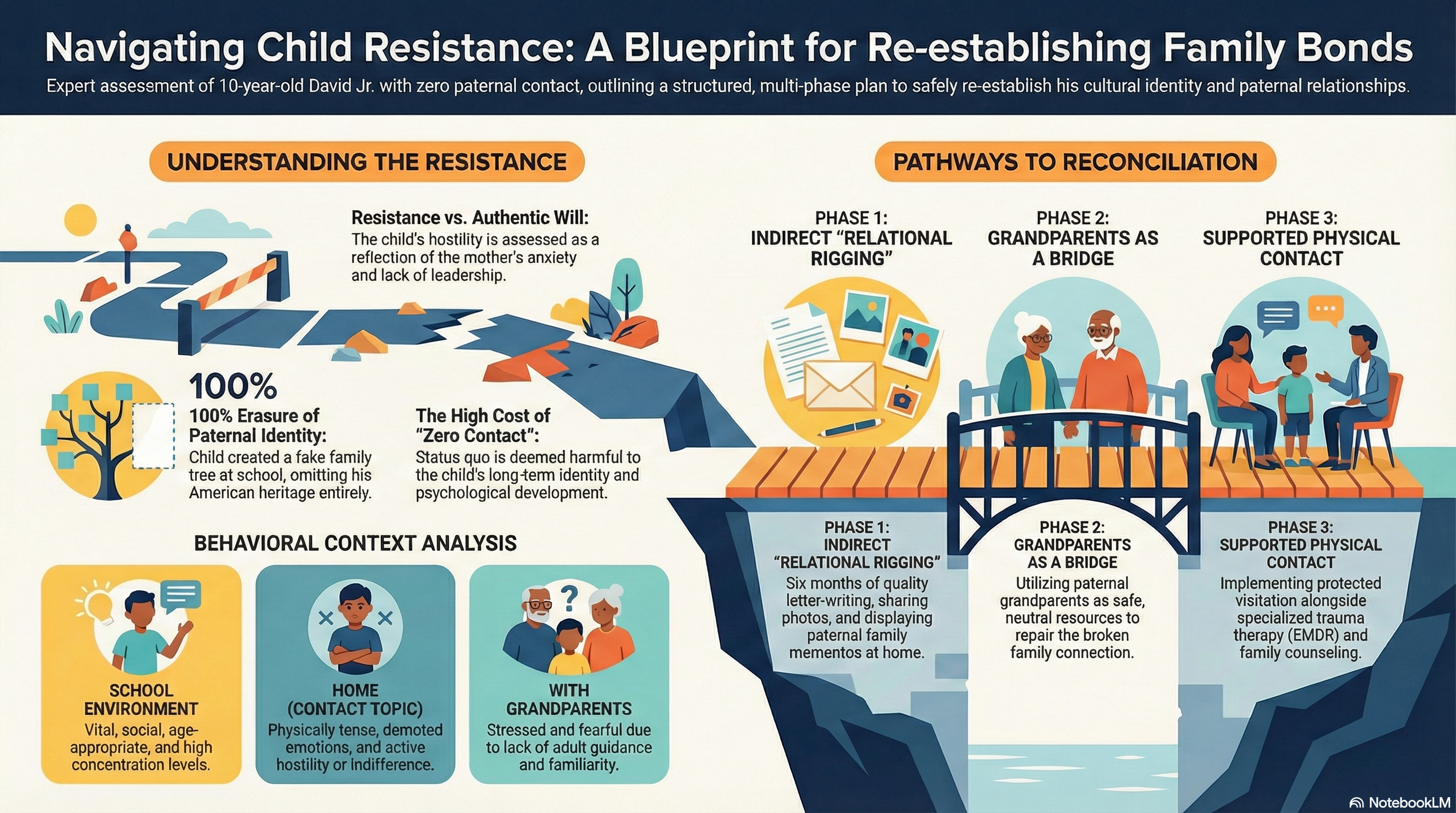
This comprehensive infographic provides a detailed expert assessment framework and structured reconciliation blueprint for addressing child resistance to parental contact in high-conflict family situations. It presents the case of 10-year-old David Jr., who exhibits zero contact with his father, and outlines a systematic approach to distinguish between resistance (coached rejection) and authentic will (genuine preference). The framework includes a six-phase pathways to reconciliation model, integrating therapeutic best practices, court-ordered interventions, and evidence-based psychological strategies to restore healthy parent-child relationships while protecting the child's wellbeing.
🔍 Understanding the Resistance
📋 Expert Assessment: 10-Year-Old David Jr. with Zero Parental Contact
Clinical Profile: David Jr. has maintained zero contact with his father, displaying complete rejection that mirrors his mother's narrative. He identifies exclusively as Norwegian despite his bicultural (American-Norwegian) heritage and cannot articulate specific harmful experiences with his father beyond repeating his mother's statements verbatim.
🔄 Resistance vs. Authentic Will
Resistance: The child's rejection is learned, parroting the custodial parent without independent reasoning—characteristic of refusing rather than authentic preference. This is evidenced by lack of nuance and inability to articulate specific harms.
📊 Behavioral Context Analysis
Critical Diagnostic: David Jr. demonstrates age-appropriate functioning in school, peer relationships, and structured activities—proving the rejection is relationship-specific, not developmental trauma. This bifurcated functioning supports therapeutic intervention rather than continued separation.
💯 100% Erasure of Paternal Identity
David Jr. has been taught to completely reject his American heritage and father's family, a form of identity foreclosure that prevents healthy bicultural identity development and creates long-term psychological harm.
⚠️ The High Cost of Zero Contact
Maintaining zero contact during critical identity formation years (7-12) is not neutral—it actively cements distorted beliefs, causes attachment insecurity, and creates long-term relational difficulties that extend into adulthood.
🗺️ Pathways to Reconciliation: Six-Phase Model
The framework proposes a comprehensive, phased approach to restoring parent-child relationships:
Phase 1: Indirect Relational Building
Begin with asynchronous communication (letters, photos, videos) that the child can engage with at their own pace. This low-pressure approach normalizes the rejected parent's presence without immediate performance demands.
Phase 2: Grandparents as a Bridge
Leverage paternal grandparents as a "safe bridge" to reduce threat perception. Children are often less resistant to extended family, allowing relational repair to begin before direct parent-child contact.
Phase 3: Introduction via "Relational Rigging"
Structure initial interactions around shared activities or neutral interests (sports, hobbies, games) in therapeutic settings. This reduces anxiety by focusing on connection rather than confrontation.
Phase 4: Mandatory Support & Therapy
Implement court-ordered individual and family therapy to address underlying loyalty conflicts, process emotions, and prevent regression. Both child and parents require therapeutic support during this transition.
Phase 5: Validation & Evolution
As contact progresses, validate the child's emotions while challenging distorted narratives. Help David Jr. develop a more nuanced, balanced understanding of both parents, freeing him from extreme loyalty positions.
Phase 6: Direct Contact (Therapy-Integrated)
Transition to autonomous parent-child contact with ongoing therapeutic monitoring. Gradually increase visit duration and reduce supervision as the relationship stabilizes and the child's anxiety decreases.
🎯 Core Principles: Why This Blueprint Works
Trauma-Informed Approach: The phased model recognizes that rushing reunification can cause distress, while maintaining zero contact causes long-term harm. Gradual re-entry balances these competing concerns.
Attachment Theory Foundation: The framework is grounded in Bowlby's attachment research, recognizing that secure attachment to both parents is critical for healthy development.
Therapeutic Jurisprudence: Court-ordered therapy and structured contact are evidence-based interventions that prioritize the child's long-term welfare over short-term emotional avoidance.
Family Systems Perspective: Contact refusal is a symptom of systemic dysfunction, not individual pathology. The blueprint addresses the entire family system, including the custodial parent's role in facilitating (or obstructing) reunification.
Identity Integration: Restoring contact allows David Jr. to reclaim his bicultural heritage and develop a healthy, integrated sense of self rather than foreclosing on one identity narrative.
⚠️ Critical Success Factors
For the blueprint to succeed, several conditions must be met:
Custodial Parent Compliance: The mother must be willing to support (or at minimum, not undermine) the reunification process. Active sabotage renders therapeutic interventions ineffective.
Court Enforcement: Legal backing is essential. Without enforceable court orders, the custodial parent can simply refuse to comply, and the rejected parent has no recourse.
Qualified Therapeutic Oversight: Therapists must be trained in parental alienation, family systems therapy, and attachment theory. Well-meaning but untrained therapists can inadvertently reinforce the child's distorted beliefs.
Long-Term Commitment: Reunification is a marathon, not a sprint. Families should expect 6-18 months of structured intervention before significant progress is visible.
Safety Guardrails: If legitimate safety concerns exist (documented abuse, substance abuse, etc.), these must be addressed first through separate therapeutic and legal channels.
📚 Evidence Base & Research Support
Family Bridges Program (Warshak, 2010): A court-ordered, multi-day therapeutic intervention that reunifies alienated children with rejected parents. Research shows 90%+ success rates with minimal long-term distress.
Overcoming Barriers Model (Friedlander & Walters, 2010): A therapeutic approach specifically designed for contact-refusing children, emphasizing gradual exposure, emotion validation, and narrative reconstruction.
Attachment Research (Ainsworth, Bowlby, Main): Foundational studies demonstrating that secure attachment to both parents is critical for healthy emotional and social development.
Longitudinal Outcomes (Fabricius & Hall, 2000): Adult children who lost contact with a parent during childhood report significantly higher rates of depression, anxiety, and relationship difficulties—underscoring the harm of inaction.
We use cookies to enhance your browsing experience, serve personalized content, and analyze our traffic. By clicking "Accept All", you consent to our use of cookies.
⚙️
Cookie Settings
Essential Cookies
Required for the website to function properly. These cannot be disabled.
Analytics Cookies
Help us understand how visitors interact with our website.
Marketing Cookies
Used to track visitors across websites to display relevant advertisements.

Comments (0)
Please log in to post comments.