AI-generated: made with Google NotebookLM from public sources and Do Better Norge material. Check figures against the cited sources before quoting them.
Zoom and pan to explore details
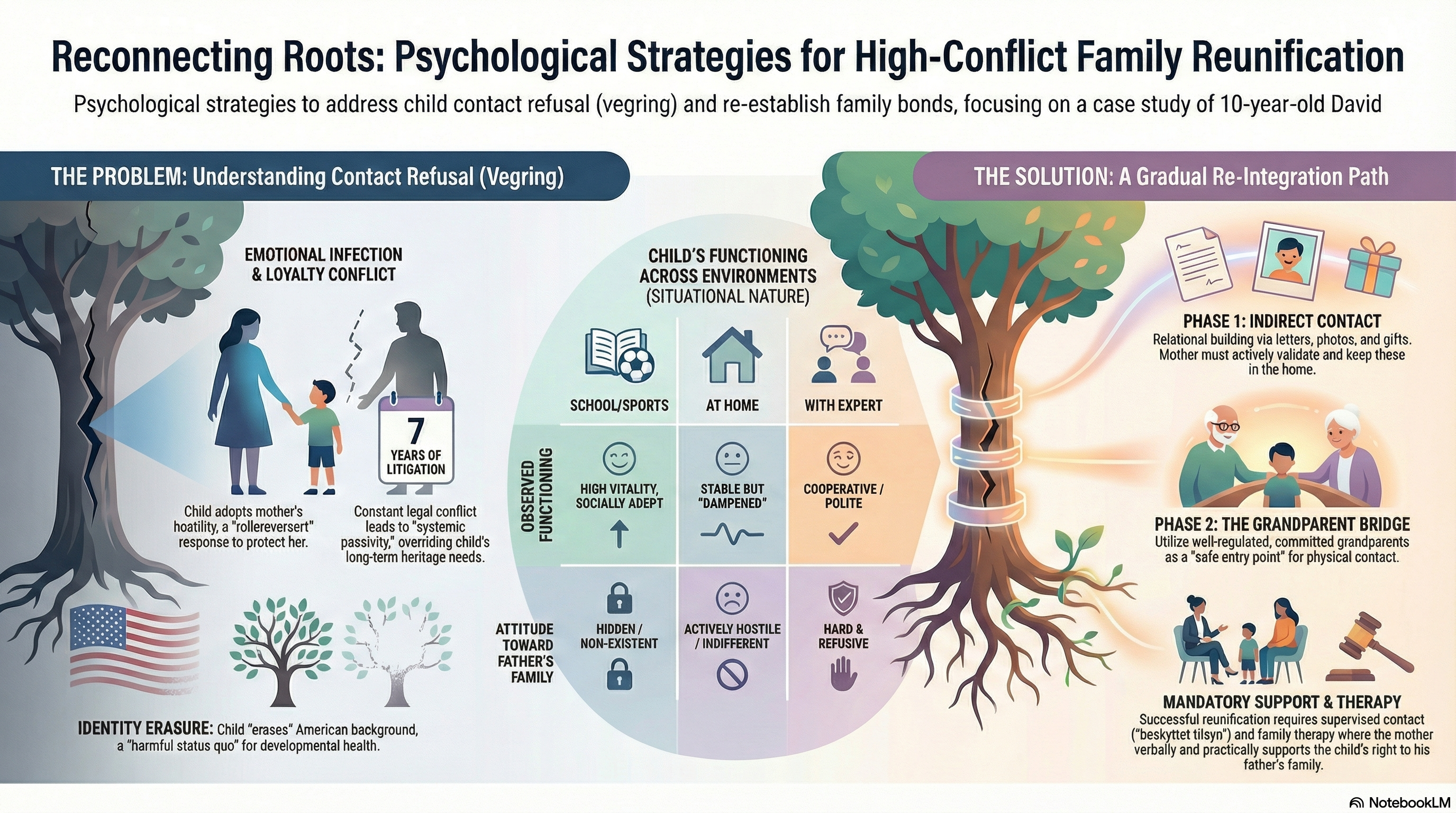
This detailed infographic presents a comprehensive clinical case study of 10-year-old David, who has experienced zero parental contact for an extended period following high-conflict separation. The analysis examines the psychological mechanisms behind contact refusal—specifically emotional infection, loyalty conflict, and bifurcated functioning (where the child performs well in some environments but exhibits rigid rejection in family contexts). It proposes a gradual re-integration pathway featuring Phase 1: Indirect Contact, Phase 2: Grandparent Bridge, and Phase 3: Direct Supervised Contact, grounded in attachment theory and therapeutic jurisprudence.
Presenting Issue: Complete rejection of paternal contact, identifying as "100% Norwegian" despite American-Norwegian heritage. David parrots his mother's negative statements about his father verbatim, showing no independent reasoning or nuanced understanding.
Key Observation: David functions normally at school, with peers, and in structured activities—demonstrating that the rejection is relationship-specific, not a global developmental issue.
David has absorbed his mother's distress and hostility toward his father through emotional contagion. To reduce cognitive dissonance, he has taken an extreme "loyalty stance," completely rejecting the father to align with the custodial parent.
Critical Diagnostic: David's age-appropriate social skills, academic performance, and emotional regulation in non-family settings prove the rejection is not rooted in developmental trauma but in relational dysfunction.
David has been taught to reject his American heritage entirely, a form of identity foreclosure that impairs healthy self-concept development and creates long-term identity confusion.
The proposed intervention uses a phased, trauma-informed approach to restore David's relationship with his father while minimizing emotional distress:
Goal: Re-introduce the father's presence without performance pressure.
Method: Asynchronous communication (letters, photos, video messages) that David can engage with at his own pace. This normalizes the father's existence and begins to challenge the "all-bad" narrative.
Goal: Use paternal grandparents as a "safe bridge" to reduce threat perception.
Method: Supervised visits with grandparents in neutral settings. Children are often less defensive about extended family, allowing relational repair to begin indirectly before direct father-son contact.
Goal: Establish direct father-son interaction with therapeutic oversight.
Method: Brief, structured visits in therapeutic settings with gradual increases in duration and autonomy. Mandatory support therapy (individual and family) to process emotions and prevent regression.
Maintaining zero contact during critical developmental periods (ages 7-12) is not neutral—it actively causes harm:
The intervention aims to achieve the following measurable outcomes:

Comments (0)
Please log in to post comments.